Hi, I'm Misty, Christian life coach for busy and ambitious moms. I help women discover and develop their own unique rhythms that allow them to stop dwelling and start dancing to a beautiful and abundant life.
A conversation between Misty Hughes and her daughter Morgan. Unscripted, and lightly edited for reading.
00:00 Morgan: I have people in my life, in my home, I would say to a much greater extent than the average person does, and yet I still feel so lonely so often. And it feels — bad. Like it feels like a bad feeling, and so I wanna get away from that feeling. I wanna get out of it. It’s a pain. It’s pain. Loneliness is pain. And what do I do about it? Mom? I need answers. Misty: Hey there. Welcome back to Mom to Mom Mentoring. Yes, you’re in the right place. I’m Misty Hughes, and if you’re new here or if you’ve been with me a while and you’re wondering, “Whose voice is that I hear?” We’re in season number two now, and things look a little different around here. I’ve invited my daughter Morgan to co-host with me. She’s not a guest. She is a co-host. We’re having the same conversations here in the podcast space that we’ve been having for years on the phone. You heard Morgan introduce the topic today. Yeah, loneliness. It’s a conversation we’ve had a number of times on the phone, and what Morgan discovers this time around about halfway through is something you are not going to want to miss. It was revelatory to both of us. And a little bit about what’s ahead for this season. We’re gonna talk some about our spiritual differences and how the two of us make room for each other’s view without either of us ever having to be wrong. We talk about ceremony and ritual and what place those things hold in our lives, and how they’ve made and molded us and how they have brought us back together. We have some genuinely fun conversations too. So hit subscribe. You don’t wanna miss what’s coming. And if this podcast has meant something to you, I have a huge favor. Would you take 30 seconds and leave a review? That’s how other moms are gonna find their way here. Okay, are you ready? Let’s get into it. Morgan: And we’re back. Okay. Three, two, one. Clap, clap. We’re here today. We debriefed yesterday and preselected some topics that we’re gonna try to get through today. Where we’re gonna start off with is the lighthearted topic of loneliness. Because it’s something that I think about and I experience a lot, and I wanna talk to Mom and pick her brain a little bit. We were talking yesterday about our timeline and stories, and married for 13 years and single for how long? Misty: 22. Morgan: Are you serious? Misty: Me? Yeah, I was… Yeah. Morgan: 22 years. I thought that’s what you said, but then I thought I misheard, ’cause that’s so long. It is. It’s like over two decades. No way. You’re not even that old. That math doesn’t math. How old were you when you got divorced? Misty: I was 36. Morgan: Yeah. Okay. Never mind. That’s crazy. 22 years. So for podcast purposes — my parents got divorced, you dated someone briefly, and then decided that that wasn’t in the best interest of her kids, to date someone and to jump into a relationship. So according to my recollection, you also had biblical convictions that remarriage was not right. Misty: Yes. That’s true. Morgan: Can you go into that a little bit more? Misty: There are different passages about divorce. In the beginning, I read that if a man marries a divorced woman, it’s as if he commits adultery. I think it was right for the moment for me. And when it was time, I did. I was like, “Okay. I see a whole different aspect of God’s heart here.” 04:14 Morgan: I think being single for 22 years after divorce is unusual. Especially for a hot number like you. Misty: I know, right? Morgan: And so I think it’s important context — that in some part it was spiritual conviction, and in some part that conviction aligned with your feeling that that probably wasn’t in the best interest of your kids anyway, to bring another person into the situation. And I think that in and of itself is interesting and really different. I think also a lot of people look at remarriage as an economic provision source for their family, and we were poor. Misty: We lived under the poverty level. Morgan: And we were on food stamps, and went to food drops and stuff like that, and got milk. Expired milk. Lots of expired… You know, I still sniff the milk carton. So I think that’s a rationale for some people. Also, for women especially, who weren’t the primary income earners — it’s like, “I wanna remarry for the financial stability.” That was not a factor. We did not have an abundance of income. You still felt like it was both God’s will and in the best interest of your kids for you to be a single and primarily stay-at-home mom. Misty: I remember sitting on our basement floor, and I actually thought about remarriage. I thought, “Okay, what if I remarry? The likelihood is that if I remarry, he’s gonna have come from a divorce, and he’s gonna have kids, and an ex, and there’s gonna be that dynamic, and then there’s gonna be this dynamic.” And I started to think about all the relational dynamics. And I thought, “I will probably end up in a mental hospital if I remarry.” Relationship is so important to me, and having time and capacity to sow into relationship — and I just thought, “There is no humanly way I can do that.” So that was part of it, too. Morgan: And also, there were four children, all who responded very, very differently to being in a single-parent home, and all who had very different emotional and behavioral and academic needs — and you were homeschooling at the time. I think that’s important context. And then you were single and living alone. For how long? Misty: I don’t know. Six years or so. Morgan: So let’s pick up the story there, ’cause that’s relevant to me. I don’t have kids, and I am single, living alone. And so what was that like? You didn’t have any more kids at home. Having kids at home — I think that’s even different than choosing to be single, because you have literal humans that you are caring for, living in your home. So what was it like, the transition from having kids at home that you’re taking care of to living alone? And did you feel lonely? Misty: Yeah, and so that’s the crux of what we want to cover today, is this issue of loneliness. “And I just wanna say — I’ve always felt lonely.” MISTY Misty: And I just wanna say, I’ve always felt lonely. Morgan: Really? Misty: There have always been more intense seasons of loneliness and less intense seasons of loneliness. After Jacob had moved out, and I was turning 50 — And I felt like I was entering into a desert of loneliness. And I didn’t wanna go there. Morgan: For sure. 08:05 Misty: I felt like there was an invitation, and then I bought this book by Elizabeth Elliot — whom we know — and on the cover of the book was the picture that I kept seeing, and I was like, “Oh, Jesus, I don’t wanna go there.” And I was down in my back. I was bedridden pretty much, unless I took about eight ibuprofen. And then it would take me 20 minutes to get out of bed. And so there was just this whole season of physical pain — — and the emotional pain of loneliness, and what am I gonna do with this? In my mind I could see, I can go back the way I came, right? I can go back to all the things I know that kind of fulfill me and satisfy me and help me avoid loneliness. I can go to the right or to the left. I can go to this experience or that experience. But what I knew for me is every time that God invited me into this season, into this space, something beautiful came out of it. Morgan: But you had never been in this season or space before. Misty: I hadn’t been in that particular one, but I had been in spaces and seasons of loneliness. Like I said, loneliness has been an ongoing part of my journey — as an adolescent, as a young mom. Morgan: But you had never lived alone before. You were 50 years old before you lived alone. Misty: It was a new experience. You’re like, “Okay, God was faithful there, so He’s gonna be faithful here.” “And if this is an invitation from Him to step into this place and space, then He’s gonna be faithful to meet me.” And so I just said yes. I think sometimes I ran away from it. I’m like, “I’m gonna go back to what’s comfortable, what feels good, to my people.” Morgan: What could you even go back to? ‘Cause this was a new place. Misty: Well, I could go back to my friends. I could go back to work. Work fulfilled me, because I had the nonprofit, right? That was so fulfilling to me. I loved it. I loved creating programs. I loved speaking. Even though I was in physical pain, I would still get up and go to networking meetings, and I’d be like, “I just have to schedule an extra hour on the front end to get me there.” And so probably two or three times a week, I’d be like, “I’ve got to get out because I’ve got to keep the nonprofit’s name in front of people. And, oh, I’ve got this coffee date.” This was pre-Zoom meetings. I could find things to distract me. Morgan: But you didn’t stop doing any of those things, did you? Misty: I never stopped fully, no, because I had a nonprofit. But am I doing those things to avoid feeling loneliness? So it’s just like any other emotion. Grief. Like, if we avoid grief, it’s not gonna go away. It’s just gonna come out in other ways, right? And so there’s a process of walking through grief and knowing the ebbs and flows of grief. I feel like loneliness is the same thing as any emotion. It’s like, I can avoid this — or I can embrace it and say, “This is a part of life, of my journey, and what am I going to do in the loneliness?” 11:53 Morgan: Okay. So what I’m hearing you say is that your actions, your behavior, your lifestyle didn’t really change, but your attitude about why you did these things or didn’t do these things changed? Well, I just — I’m not satisfied. Misty: Okay. So my actions did change, because I was in pain. Morgan: So you could do less. Misty: So I could do a lot less. Morgan: So doing things actually wasn’t an option. Misty: There was no nightlife. There were no social things. It was just — Morgan: Do the bare minimum. Misty: Do what I need to do — Morgan: — to keep things in motion. So your season changed, you were living alone, then also your options for activity and mobility changed. So you were KTLO — keeping the lights on — in terms of the business, in terms of what you needed to do as the executive director to keep the nonprofit visible. So you really couldn’t have gone out and done a bunch of stuff even if you wanted to, because you were physically prohibited. You were immobilized. For how long? Misty: It was probably a good six-month journey. I remember crying in bed because I was so lonely, and I would just be like, “Can’t somebody come?” Morgan: And so you were lonely. And in a new way, would you say? Misty: Yes. I would say it was a new experience of loneliness that I had never experienced before. Morgan: Then there were six years where you still lived alone. But in that period, were you lonely? Misty: Yeah, I was. At one point I looked at my schedule and I was like, “Oh man, I’m working 80 hours a week. That’s probably not healthy.” Morgan: Did you change that? Misty: Yeah, I did change that. I think I was looking for an escape. I didn’t want to feel the quiet of my home. So I would just exhaust myself. I’d come home and fall into bed, and get up and… And I loved what I did, so it was a good way to escape. Morgan: This is something — I think we’re getting now to what I’m curious about too. Do you think that you and I are wired to live alone? I think that there are some people who, that’s their default, and they wanna go home and be alone and watch TV or read, and just have that quietness. But you and I resist it. We’re like, “No.” And I describe myself as a petulant child. I do not wanna go to bed. I so hate going to bed alone, and I put it off, and I wake up as early as I can. And I exercise a lot because I feel like I need to be physically exhausted in order to sleep. I love my home and I love my space. I describe myself as a very high-functioning introvert. If I don’t have extended periods of time alone, I naturally — like once a month, I’ll just have almost 48 hours where I don’t have human interaction, because I just need to gather and regroup and recharge. But I feel this resistance in the fiber of my being in living alone. And until I was divorced, I had also never lived alone. I lived with my family, and then I lived with roommates, and then I lived with my spouse. Period. And so now I’m four years out. I’ve been divorced for four years. I don’t like listening to podcasts and stuff while I drive or whatever, because I like to say I need quality time with my favorite person, me. Like, I like being alone with myself. I love being alone with my thoughts. I love sitting on the porch and reading poetry and writing in the evenings. And so it’s not even that I’m uncomfortable with myself — but I just crave community and communing all the time. And even this week, you’ve been here, and we’ve been together all the time. We have our little — we say good night and take our time and do things. And I’m like, “Man, this is so great.” And so I wonder, like — 16:12 Morgan: I know you and Craig — Craig my stepdad — are like, “Morgan, you just need to be single for a couple of years.” And technically I have been. And I just like — do I? Misty: Well, okay. So I think there is a difference between being alone, living alone, doing things alone, and feeling lonely. I say this with love toward my husband, but I have felt so lonely sometimes in my marriage. Morgan: Yeah. I think that’s normal. Misty: I think if we are looking for a human being to fix our loneliness — which I don’t hear that’s what you’re saying. You love being in community, in communion with human beings, and it’s not about you trying to fix your loneliness. It’s about the fact that that’s just who you are to your core — that you love people, and you love to love extravagantly. And it feeds your soul to know that someone else is being loved and cared for — especially if you get to be the one that does that. That’s not the same as being afraid or feeling lonely. That’s just who you are. Morgan: Well then, what do we do about it? Misty: Yeah. That’s a good question. What do we do? Morgan: Because I am abundantly — and I would say probably exceptionally — rich in community. I am lucky. I have a job that I love, in office. I go to work happy every damn day, and definitely have to do hard things. Like, I’m never like, “Oh, yay, Monday morning, 8:30. I have to terminate an employee. This is gonna be great.” But I love what I do. I love the people I work with, and I experience joy all the time in the place that I work. And then I have a wonderful gym community, and people who I have known for 14 years. I have deep, rich friendships. I have people over — I feed people at my house at least four times a week. I have people over for dinner and lunch and cook, and I know all of the neighbors. We had happy hour with my neighbors. I know all of the neighbors on my street. And I came home from happy hour with one neighbor, and my other neighbor had fed my dog and watered my garden — unasked. “I have people in my life, in my home, to a much greater extent than the average person does — and yet I still feel so lonely so often.” MORGAN Morgan: And so I have people in my life, in my home, I would say to a much greater extent than the average person does, and yet I still feel so lonely so often. And it feels bad. Like it feels like a bad feeling, and so I wanna get away from that feeling. I wanna get out of it. It’s a pain. It’s pain. Loneliness is pain. And we wanna pull away from pain. We don’t wanna keep putting ourselves in situations where we experience pain. And so what do we do? What do I do? Why do I feel this way? If I like being alone — and I like myself and I like my home, and I have rich community, and again, I feel like luckier than most — I love my family. We talk every week. And so why do I feel lonely? And if it’s not bad, why does it feel bad?
20:04 Morgan: And what do I do about it? Mom? I need answers. Misty: I can only respond — Morgan: No Jesus stuff. Misty: It’s gonna be Jesus stuff. Morgan: No, ’cause you felt lonely even with Jesus, so that doesn’t satisfy me. Misty: I felt lonely with Jesus, but I had somebody to go to with my loneliness. Morgan: Well, I do too. Misty: It wasn’t just loneliness unto loneliness. It was — Morgan: I have a therapist. Misty: It was loneliness unto, “You have got to touch these deep aches in my soul, because if you don’t, I don’t know where they will lead me.” Morgan: But you said you still feel lonely. Misty: I do, and I still go to Jesus when I feel lonely. I think it’s a part of life. And what if… Okay, this is something that I talk to women about a lot. What if our emotions are neither bad nor good? We label them. Morgan: Sure. Misty: Right? This is bad because it doesn’t feel like joy or hope or whatever.
What if it’s neutral? It’s neither bad nor good. What if it just is? And I think the question is — what does it want to teach me?”
MISTY
Morgan: Okay, I can get on board with this metaphor. Misty: Okay. Morgan: Or I can accompany this with a metaphor that I — Misty: Oh, you got a metaphor. Woo. Morgan: Yeah. I love metaphors. It’s like being hungry. And being hungry doesn’t feel good, and we wanna not be hungry as soon as possible. But also, we have to feel hungry to feel full and to feel satisfied. And the key — I like being good hungry. I like feeling ravenous. I don’t snack a lot. I only eat when I’m really hungry, because I love that feeling of being hungry and knowing that my body is asking me for something, and then giving it to me. And a bad feeling is that feeling when you’re never hungry because you’ve just been grazing all day — charcuterie and snacks or whatever — and you’re not satisfied. Neither are you hungry. That’s a terrible feeling. Literally the worst physical feeling. And maybe that’s a little bit of the pain I feel right now sometimes. Like, I don’t junk food, right? I don’t wake up and listen to stuff. I don’t go home and watch stuff. I don’t have a lot of white noise in my life. I’m very, very purist, if you will, about my intake — because I want that connection to be real authentic human connection. I’m really even intentional about who I spend time with, and who I invite over to my home, and who I go out for happy hour with, because I want it to be something that’s feeding me and satisfying me and not just filling time and space.
“Maybe loneliness is like hunger. And you have to know hunger to know satisfaction.” MORGAN Morgan: So maybe loneliness is like hunger, and you have to know hunger to know satisfaction, and you have to give yourself really good, satisfying protein and fiber-rich nourishing food to feel that goodness and care. And then you know that you’re gonna go to the gym, you’re gonna work, and you’re gonna feel hunger again. And maybe loneliness is like that, because I don’t feel lonely all the time. But I feel it very acutely, often. And so maybe loneliness is like that, and we feel this loneliness because it creates this desire and craving for good and rich community and connection that feeds your soul. And if you fill it with good things and good people and good poetry and ideas and concepts that make you feel curious and alive, then you feel full and satisfied. And then it wears off, and you get hungry or lonely again, and then you seek out that connection and that community, and you can feast — in fellowship. How does that work? Does that make sense? 24:15 Misty: That makes sense. That makes sense to me. I think that you defined it for your person, and as I’m hearing you, I’m like — you have such beautiful awareness. Even let’s just go back about hunger. Like, so many of us, when we’re hungry — oh my gosh, where are the chips? You know, where’s the sweet… Whatever we can get our hands on that’s convenient, we’re going to shove into our mouth to try to satisfy that hunger, because it’s uncomfortable. Whereas what you’re telling me is that you have disciplined yourself to do, because of the satisfaction you get on the other end. It’s just like today — we were so hungry. We’d worked out twice, and you came home and you made this beautiful salmon salad. So satisfying — Morgan: So good. Misty: — to our soul. But we could have just come home and been like, “Oh my gosh, I’m so hungry. Where are the tortilla chips? Where’s the salsa? Where’s the sweet treat or whatever?” And we would have, like, ugh. Morgan: And we would’ve felt sick. Misty: We would’ve felt sick. Morgan: Instead of feeling satisfied. What a poor exchange. Misty: Yeah. And so what you’re telling me is that’s what I do with loneliness. Morgan: I think so. Misty: And one thing I think of is because, again, we think of this as bad or wrong, or “I shouldn’t feel this.” Who has told us that, number one? Who has said it’s bad, or we shouldn’t feel this — and if we feel this, it means something’s wrong? What if it’s just an invitation to understand ourselves better, or understand something? One thing I have women do a lot, if they’re experiencing this emotion or something, I’m like, “What if this were a person? What would loneliness look like?” Like, if you personified loneliness, what would they look like? Morgan: Are you asking me this question? Misty: If you want. “I think it would be gaunt and hollow. Like it would look like hunger.” MORGAN Morgan: If you want me to. I think it would be gaunt and hollow. Like it would look like hunger. It would look like a hungry, malnourished, empty person. Misty: And what if you befriended loneliness? Morgan: Well, I would have to feed it. Misty: You’d have to feed it. Morgan: Yeah. I would have to say, “Oh my God, you look ravenous. Let me feed you. Come inside.” Misty: Come inside. Morgan: “Let me feed you. Let me nourish you. Let me give you hopefully the best meal you’ve ever had — because you are hungry, and I will feed you.” Misty: And I bet loneliness would have some great wisdom or insight to share with you about their journey. Morgan: I mean, yeah, maybe. Misty: Maybe. Morgan: I don’t know if this is working for me. Misty: Okay. That’s fine. Morgan: The personification of loneliness. Misty: But it’s really about, instead of pushing it away — saying, “This is a part of life, and so what if it was okay, and it wasn’t bad?” 27:49 Morgan: We’re averse to things that feel bad, right? It’s a survival instinct to avoid things that cause us pain, or people that cause us pain. If you touch something hot, you’re not gonna touch it again, because it hurt you. And so I think loneliness feels like pain. And hunger feels like pain. Morgan: And so I don’t — again, I don’t think it’s bad. I don’t think that hunger is bad, as long as it’s temporary and there’s a reprieve from it. Hunger indefinitely is starvation, and that is perishing. That’s dying. You will die if you don’t eat. And loneliness, I think, is the same. You will die, you will perish. Your heart and your soul will perish if there’s not a reprieve from the loneliness, if there’s not the satisfaction of your soul, if you don’t get to feast with fellowship. Just like if you don’t get to eat food, then you will die. And so I don’t think it’s bad. I think it’s necessary. And I don’t think that we can experience satisfaction of community and that richness without the preceding loneliness. Because it’s like when people are like, “Heaven, there will be no more pain,” I’m like, “Well then how will you know joy?
If you don’t know pain, how will you know joy?” “The existence of one necessitates the other — and sharpens the experience of the other.”
Morgan
Morgan: Because the existence of one necessitates the other and sharpens the experience of the other. And so I don’t think that pain, sorrow, sadness, grief, loneliness — I don’t think any of these things are bad. But I also think that they are passing, or a part. They’re not the whole. The full experience is hunger and satisfaction — is loneliness and fellowship, I think. And so maybe just even as I’m talking, maybe a good helpful reframing for me is just to not reside in this fear, because that’s what really gets scary. That’s what really is bad. That’s when loneliness turns bad — when you’re afraid that you’re always gonna be lonely and that you’ll never not feel this way again, and then you make bad decisions. And the same is true for hunger, right? If you’re like, “Oh my God, I don’t know when I’m gonna get my next meal. I better eat this crappy thing in front of me right now, because something is better than nothing and I don’t know when the next nourishment will be available to me.” Then you make that decision, because you’re, again, trying to meet your need. And so I think that the reminder for myself in those moments where I feel loneliness is not that this is bad. Loneliness is a precursor to something, and it is a necessary heralding of what is next, and it is a preparatory feeling or experience for the satisfaction of community. And so I think that for me, I’m even envisioning myself the next time I feel lonely, or when I say goodbye to you and I cry — although I am saying goodbye and you’re dropping me off at the airport and I’m going to Nashville to a concert with a friend, so I won’t feel lonely immediately. It’s different. Misty: It’s different when you’re the one being dropped off somewhere than when you’re the one staying. Yes. It totally is. Morgan: Yeah, but usually when I say goodbye to a guest, an honored guest in my home, then sometimes I’m like, “Oh, thank God, I needed to be alone.” And that’s good too. You gotta stop eating at some point. Thank God the meal is over. I need to go for a walk and stretch my legs and breathe now. 31:35 Morgan: But as I’m envisioning now the next time where I feel loneliness, I think that what I’m gonna remind myself of is that loneliness is like hunger, and you have to cultivate hunger. You have to let yourself become hungry in order to feel full, in order to be satisfied — but then to set yourself up with the right nourishment of the soul and the body, to prepare for that so that you don’t feel sick. If I’m lonely, and the answer to my loneliness is I go on a dating app and set up a bunch of dates, then that could be akin to being hungry and saying, “Oh my goodness, I’m so hungry. I’ve worked out twice. I haven’t eaten. I’m gonna go home and I’m gonna eat a Ding Dong and a Swiss Cake Roll and a bag of Doritos.” And then I will feel sick, not satisfied. And I will want more after that, but I’ll also feel kind of placated and sluggish and slow, and it dulls the desire. And so what I’ll do next time I feel loneliness is I will say, “Thank you for this feeling, for this experience that’s preparing me for the subsequent satisfaction.” And I’m gonna experience these things to the fullest measure, so that I’m not dulling my own experience of hunger or fulfillment, and I can have them to the fullest. Like, I guess I’m starting to now — thanks to handy dandy metaphor — see this as part and parcel. Like I couldn’t enjoy lunch today if I had eaten, if I was full. Misty: If you’d eaten the Ding Dongs and the — Morgan: Yeah. It wouldn’t have tasted — it wouldn’t have filled the emptiness in my belly and my body in the same way if I had layered it with crap. And if I wasn’t really hungry. And so now I’m just gonna think of loneliness as a, like — Misty: Maybe like a hunger for your soul — instead of a hunger for your physical. Or maybe it’s a hunger for mental, but you gotta figure that out in the loneliness. Do I need mental stimulation? And who would that be, or what would that look like? Or is it a soul thing, where I get just deep conversation with that right person, or — Morgan: Or do I need to, you know — Misty: Go dance. Morgan: — go do something totally new and different that I haven’t done before, and put myself in a new environment. Yeah. Misty: See, it’s an invitation. Instead of like, “Oh no, this is bad. I can’t. I don’t wanna feel it because it hurts.” Morgan: But I think the solace now, as I’m thinking about it — even in my mind, the peace I feel in thinking about the next time I feel lonely — is that it is temporary, and it is necessary. And it is a part of goodness. Like I can’t be with people and be deeply satisfied if I haven’t had that craving for their companionship first. Misty: Wow, look what you just did. Morgan: Oh my gosh, look what we just did. Misty: That feels really profound for me. Because this is a conversation we’ve had a number of times. And it doesn’t seem like we’ve ever landed on something that — like an answer that is right for you. And an understanding. But just your verbal process of it, and everything, was amazing. Like, I’m gonna take it for me too. 35:14 Morgan: Yeah. It’s like even in your marriage, you’ve gotta feel lonely to enjoy the companionship of your spouse. And to crave that. You have to hunger for that connection. Misty: And if I’m trying to satisfy that in all these other ways — And I do. I’m like, this is a part of life. It doesn’t matter if I’m single or if I’m married or if I’m surrounded by my kids who I love, or friends or whatever. There’s still going to be this experience, this feeling of loneliness. And it is going to ebb and flow. And it also, for me, sometimes motivates me — not to fix it, but to sit and to think about: there is something missing in my life right now. And what is that? Is it relationship? Is it that experience? And so it gives me an opportunity — it’s again that invitation — to reflect and to take a look at what’s going on. Morgan: Yeah. Inventory. And now that I’m thinking about it, I think I subconsciously do kind of do this. Like, anytime I say to a friend, “Oh yeah, I’ve just been feeling lonely,” they’re just like, “Morgan, what are you…” There’s one friend in particular, and she’s like — I could just hear her yelling at me, in love — and she’s like, “Morgan, why are you lonely? You could come over any time. You call me.” Like, this loving Italian rebuke. And I’m like, “But no I don’t. That’s not the answer.” Misty: Right. Morgan: Like, I know this and I act on this, right? Like I know that when I feel lonely, the answer isn’t to just find a person. Misty: Exactly. That’s what we’re talking about. Morgan: Yeah. And I think I already subconsciously discerned that, and I am like, “No, no.” There have been so many times, Mom, where I’ve felt lonely and had ample opportunity to do things with people, and invitations — but that hasn’t been what I want. That’s not what I’m craving. I’m not hungry enough. Misty: It’s not the salmon salad that you’re craving. Yeah. I think you’ve navigated loneliness well. And I feel like you’ve been so self-aware of the loneliness. But you’ve been searching for understanding. Morgan: Right. Misty: And is it okay or is it not okay? And it’s true — it feels bad. Morgan: Is it bad? Misty: I know. It’s true for my life. But I mean, I think we sometimes say, “What’s wrong with me?” And there’s nothing wrong. Nothing wrong. It’s a part of humanity. Morgan: Yeah. And it is the whole experience. This is what it means to be alive. Is to feel things deeply. And I want to feel alive, and I think that’s why I’ve been — I guess we could call it unsuccessful in dating, because — Misty: I think you’ve been successful. You’ve had some good people that you’ve dated. Morgan: Oh, yeah. I mean, I’ve dated wonderful people. But the end hasn’t been the objective, right? Like, I haven’t been like, “Well, I just wanna not be lonely, so I’ll stay in this situation that I know ultimately isn’t right. Isn’t best.” And I’ve been in amazing relationships with amazing people who I admire and respect, and I’m like, “I don’t understand. On paper, this is great.” And but there’s something in me that won’t settle and can’t — even knowing that on the other side of the conclusion of this relationship is looming that gaunt figure of loneliness that I’m gonna feel knocking at my door more loudly and prominently than ever before, I’m still like, “No, that’s still good.” That is better than this. The pain of loneliness is still better to me than — Misty: Acceptance. Morgan: — than pacifying that feeling, and not a deep satisfaction. Misty: Of eating the Ding Dongs. Morgan: Yeah. Okay. Let’s not use that metaphor of my dating life, please. Misty: Okay. Morgan: Is this now when we start talking about sex? Misty: No, this is probably not a good time. Morgan: Okay. Okay. 39:57 Misty: So this feels good. Feels good. My word. That was really interesting. I think it’s so fascinating that we’ve talked about this. But again, it’s this podcast space — Morgan: I know. Everybody do a podcast with your mom. Misty: — what is, like, clarity. Da, da, da, da, dum. Morgan: It’s like we get this little hot room to really think about these questions that literally keep us up at night. And not that we’re gonna have answers, right? It’s not like I’m not gonna feel lonely again so soon. But it’s just that I have a different way of thinking about it, and a different set of bifocals to put on next time I have this feeling — that helps me see it with more clarity and bigger context, and then feel and know hope — Misty: There we go. Morgan: — in the midst of loneliness, not fear. Misty: Hard [bleep] — Morgan: — and hope. That’s right. Misty: That’s very — Morgan: The hard [bleep] and the hope. Misty: But you’ve got the hope.
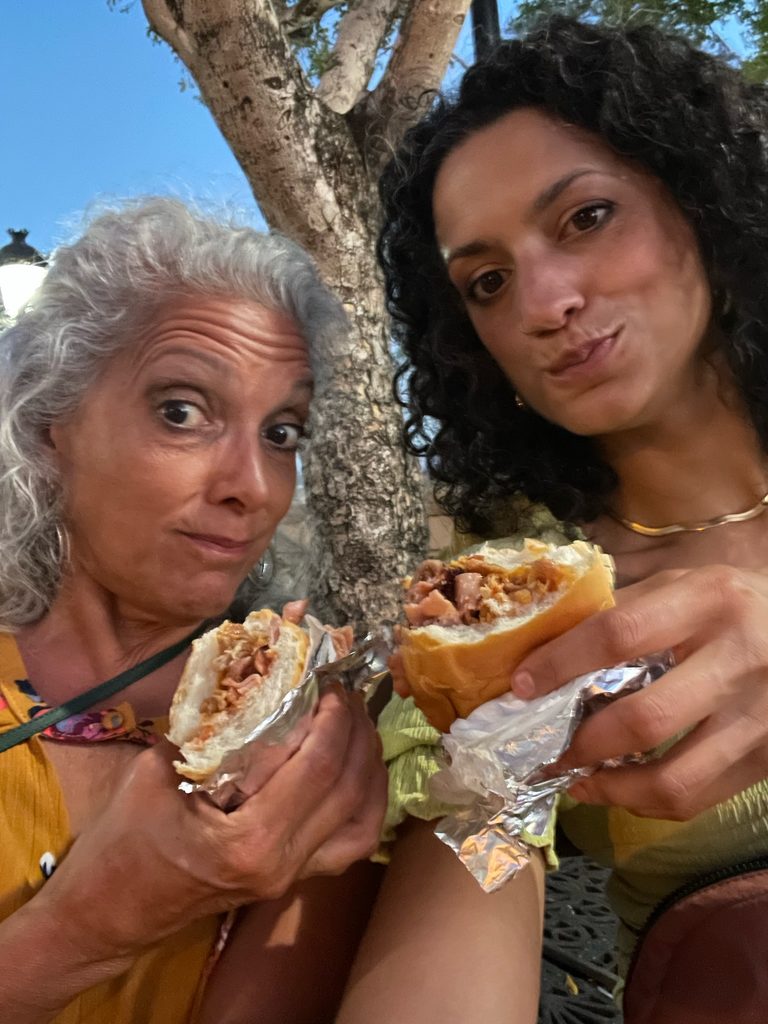
Morgan & Mom Eating
“On the other side of the loneliness, there is hope. The loneliness is a precursor for the feasting of fellowship.” MORGAN
Morgan: Yeah. And that’s the difference — that on the other side of the loneliness, there is hope. And knowledge that the loneliness is a precursor for the feasting of fellowship. And instead of, “Will I ever not be lonely again?” — ’cause that’s just false. Just like I know I will never be starving. When I’m hungry, and I’m like, “Oh, will I ever be full again?” Yes. Even though my body tells me I may not, my logical mind can kick in and say, “No, you’re gonna be satisfied, so wait for the good stuff.” And the same is true now. Like, when I feel in my being this loneliness, and my being wants to say, “Will you ever not be lonely again? Be afraid.” Instead, I can use this logic and this reasoning that we’ve given ourselves even now, and say, “No. You feel this way, but you know that you’re gonna have rich time in mere hours or mere days and be satisfied again.” And so on the other side of the hardship now, after this conversation today, is hope — for me and hope for you, instead of fear. Misty: That’s beautiful. Morgan: It’s so beautiful. Gosh. Thank you, Mom. Misty: Thank you. It’s really good. It’s just really fascinating to sit in this little space. There is nothing distracting us. It’s just our conversation. It’s just you and me in here. And sometimes when we’re talking on the phone, we’re doing laundry or we’re piddling around, and there’s a lot of other things going on. Morgan: And I think — we can’t lock in. Misty: To really discover what… you already knew. Your soul already knew it. You’ve been acting on it. Morgan: Definitely. Misty: But to be able to articulate it and have the metaphor and to go, “Oh my gosh.” That’s what’s so fun — is to watch. Morgan: Well, wrap for that one? Misty: That’s a wrap. That’s a good one. Okay. Morgan: Well, I’m Morgan and I love you. Misty: I’m Misty. I’m your mom. Morgan: You are. Misty: And I love you too.
42:57 Misty: And that’s where we’ll leave it today. If something that we talked about resonated with you, if you heard yourself somewhere in our conversation, I’d love to invite you to keep it going with me. I have a community on Facebook. It’s called Christian Moms in Business and Ministry, and it’s where I keep the conversation going throughout the week. I ask real questions, and there are real women that respond. No performing. I’m gonna put the link for that in the show notes. I’d love for you to come find us. And if you haven’t yet, don’t forget — hit subscribe and leave a review. Morgan and I, we will be back next week. And until then, remember: when you shine, you give others permission to shine, too.
This is just us, talking. If you want to go deeper into any of it, here’s where to find me.